
Tokyo Gov. Speaks Up on Green Hydrogen Drive at Global Summit
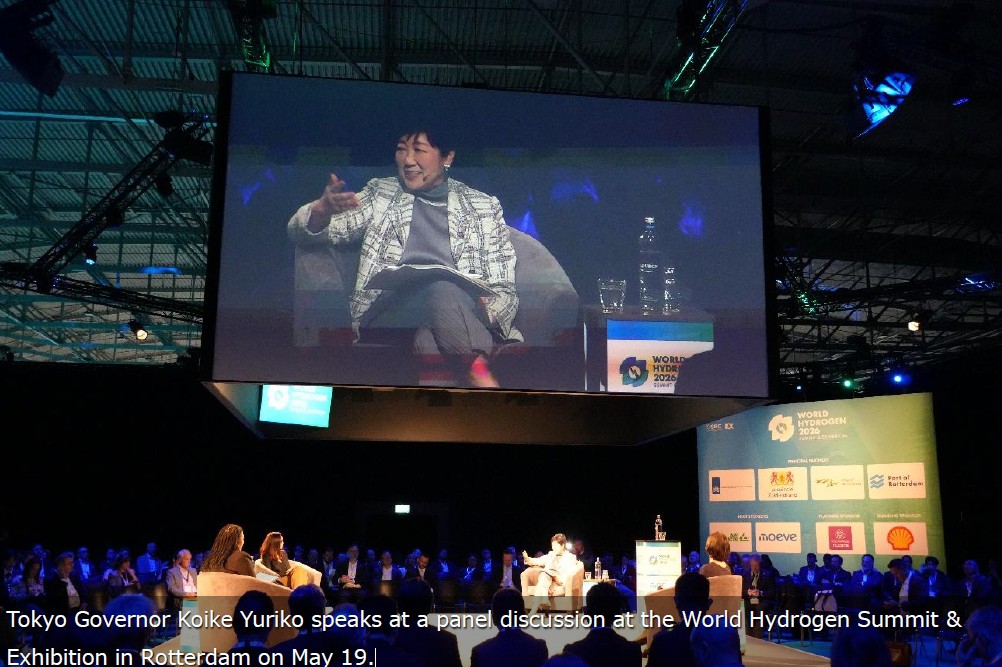
Tokyo Governor Koike Yuriko speaks at a panel discussion at the World Hydrogen Summit & Exhibition in Rotterdam on May 19.
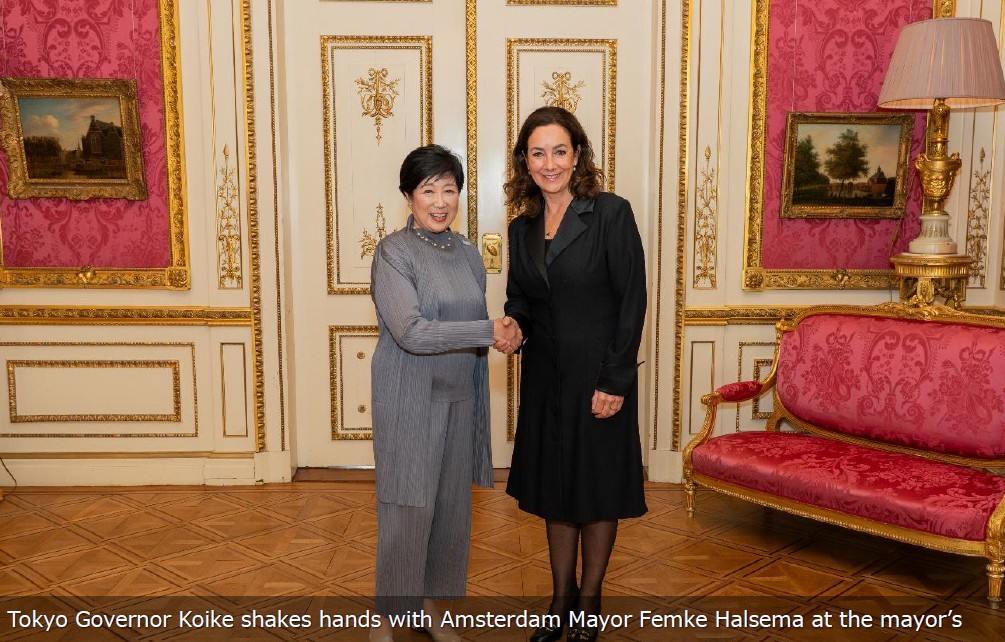
Tokyo Governor Koike shakes hands with Amsterdam Mayor Femke Halsema at the mayor’s official residence on May 18.
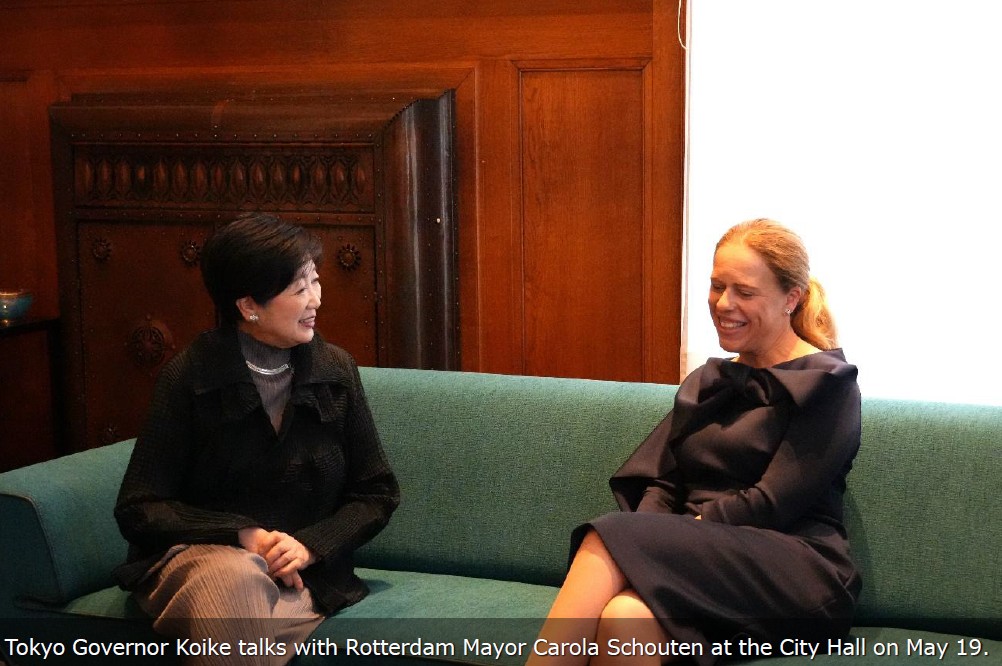
Tokyo Governor Koike talks with Rotterdam Mayor Carola Schouten at the City Hall on May 19.
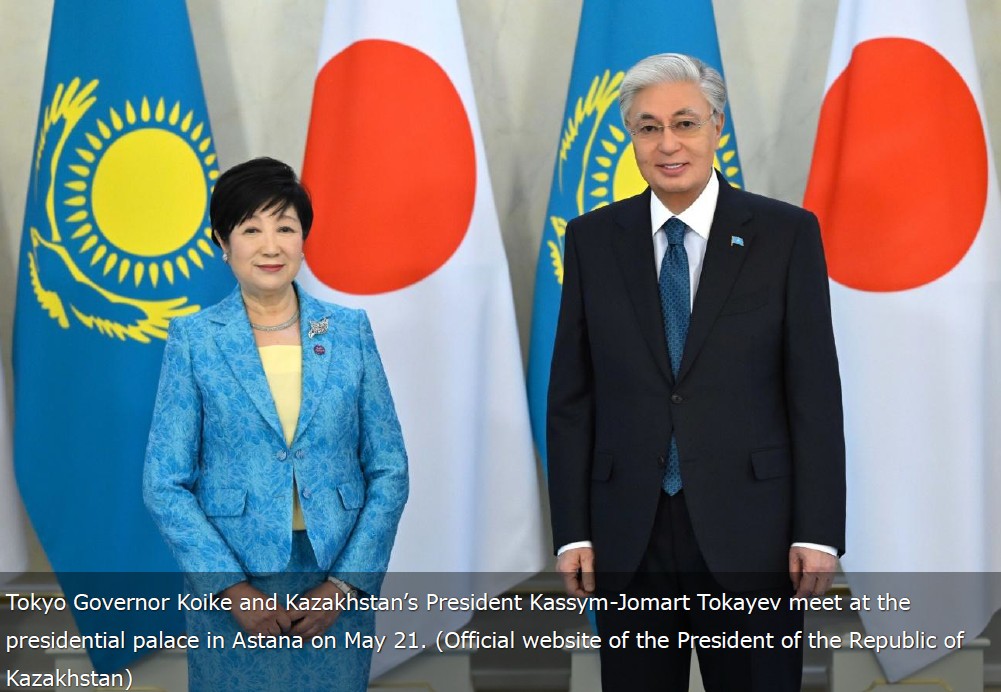
Tokyo Governor Koike and Kazakhstan’s President Kassym-Jomart Tokayev meet at the presidential palace in Astana on May 21. (Official website of the President of the Republic of Kazakhstan)
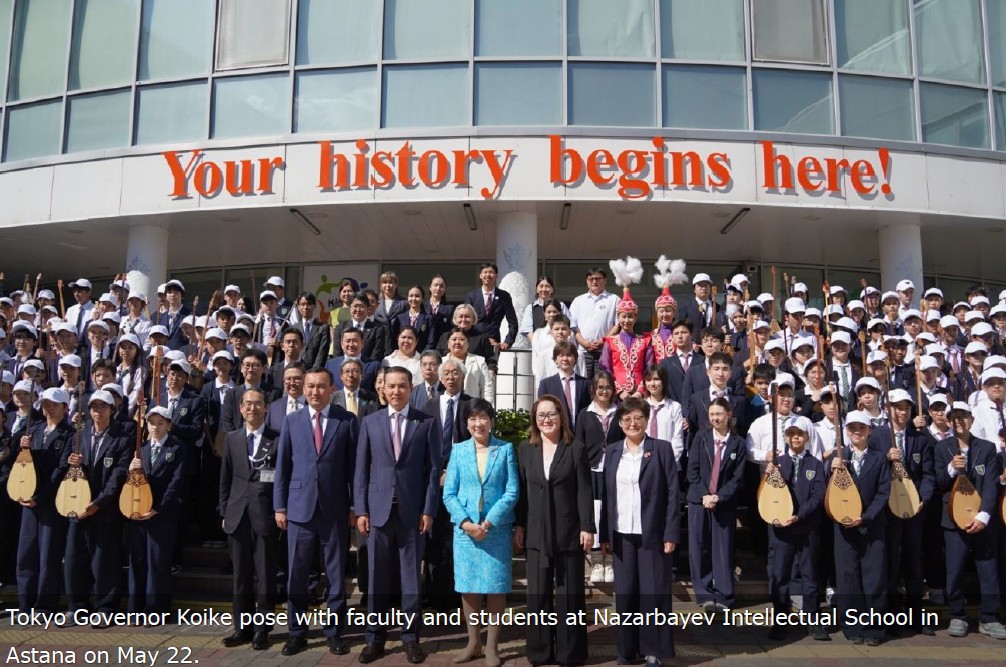
Tokyo Governor Koike pose with faculty and students at Nazarbayev Intellectual School in Astana on May 22.
TOKYO, JAPAN, June 23, 2026 /EINPresswire.com/ -- Touring the Netherlands and Kazakhstan, Tokyo Governor Koike Yuriko has showcased her city’s green hydrogen initiatives at a global conference while promoting cooperation with cities there to address shared challenges and enhance international competitiveness.
She was invited to speak at the World Hydrogen Summit in Rotterdam on May 19 and explained how her megalopolis of 14 million is utilizing the clean energy source. The governor also met with the mayors of Amsterdam and Rotterdam and saw firsthand digitalized and hydrogen-powered operations at the bustling seaports there.
Visiting the Kazakh capital of Astana on state invitation, she held separate talks with Kazakh President Kassym-Jomart Tokayev and Astana Mayor Zhenis Kassymbek on May 21 and 22. They discussed the prospects for mutually beneficial partnership—at both national and regional levels—in such key areas as digital technology, urban resilience, international finance and education.
▶ Watch the highlights from the Netherlands visit
https://www.youtube.com/watch?v=laM5pdLWxKw&list=PLBuPgafouWcmOekOfNwvJc3gsPlPyJ5Nn&index=2
▶ Watch the highlights from the Kazakhstan visit
https://www.youtube.com/watch?v=Wf1atldZEVc&list=PLBuPgafouWcmOekOfNwvJc3gsPlPyJ5Nn&index=1
[‘Very Positive Comments’ About Future of Hydrogen]
“I think there were many very positive comments,” Governor Koike told reporters on her return home on May 23 when asked about discussions at the World Hydrogen Summit amid the rising tensions in the Middle East.
“They focused on future hydrogen development and how its mechanisms should work,” she said at Haneda Airport.
“President Tokayev and I have a long-standing relationship in promoting exchanges and cooperation between our countries and cities,” the governor said in an interview in Astana with pan-European TV news network Euronews wrapping up the two-nation tour. She added that they discussed future collaboration between the two sides.
[Hydrogen Is a ‘Key Next Generation Energy’]
The annual Rotterdam summit, widely recognized as the world’s most influential hydrogen event, attracts some 10,000 attendees, over 300 speakers and more than 4,850 companies as well as over 500 corporate exhibitors, according to its official website. Participants include global executives, policymakers, and investors across diverse industries.
At a panel discussion with senior government officials from Britain and South Africa, Governor Koike shared Tokyo's initiatives to build a chain for supplying green hydrogen, which is produced using renewable energy and generates no carbon emissions. The panel was themed: Governments Stimulating H2 Demand to Meet Climate, Energy & National Security Targets.
“Ever since my post as the Japanese Minister of the Environment, I have positioned hydrogen as a key next-generation energy,” she told the panel, “and have worked to establish this by advocating its potential and importance on the policy frontline.”
Koike was elected as the Japanese capital’s first female governor in July 2016 after serving as a member of national parliament for 24 years and heading the environmental and other ministries along the way.
[Hydrogen Targets: ‘Produce, Transport, Use and Connect’]
At the session, she introduced initiatives for realizing the targets set under the 2022 Tokyo Hydrogen Vision that aims to halve carbon emissions by 2030 and achieve zero emissions by 2050. “Specifically, Tokyo is implementing its own pioneering initiatives, centering on four key words: produce, transport, use and connect,” she said.
Here are the main points of her remarks:
- Produce: Tokyo’s first hydrogen production base has been in operation. The green hydrogen produced there has been used in fuel-cell vehicles and will soon be used in the manufacture of synthetic methane. It will be utilized as a raw material for fertilizer production in the future. Production capacity will be tripled. A new production base will be built by 2028.
- Transport: Hydrogen transportation initiatives include construction of pipelines to Tokyo. Concrete studies are underway on how to transport not only domestically produced hydrogen but also imported green hydrogen.
- Use: About 150 fuel-cell buses are currently operating in Tokyo. By fiscal year 2030, Tokyo aims to have 5,000 commercial fuel-cell vehicles including trucks and taxis. And this winter, a hydrogen fuel cell-powered ferry boat will start operating in Tokyo.
- Connect: Tokyo has been operating the world’s first green-hydrogen transaction platform on a trial basis since late 2024. It is a step towards establishing a full-fledged market. “These efforts for the local production and consumption of green hydrogen, as well as its sourcing from various countries and regions, will also link directly to strengthening energy security and urban resilience,” she said.
To promote green hydrogen, the Tokyo Metropolitan Government has also been annually hosting the Hydrogen Energy Conference for Action (HENCA) since 2023, bringing together key figures from cities worldwide and private-sector executives.
[Dutch Port Cities Offer Tips for Tokyo’s ‘Sustainable’ Future]
The governor’s second official overseas tour this year started in the Dutch capital of Amsterdam on May 18 when she met with the city’s mayor, Femke Halsema. She also held talks with Rotterdam Mayor Carola Schouten on May 19.
“We exchanged views on green hydrogen, urban resilience and startup support, and confirmed the importance of major cities collaborating to address common challenges,” she told Euronews.
At the airport media availability, the governor said: “Both Amsterdam and Rotterdam are global logistics hubs. And since they are utilizing digital transformation and hydrogen in their port operations, I found their approach very informative for our side.”
Her stay on the Dutch coast also gave her chances to tour cutting-edge facilities: Growy Amsterdam, a fully automated vertical farm using AI, robotics and renewable energy, and Floating Farm, a floating dairy farm in the port of Rotterdam. The platform produces fresh dairy products, including milk and yogurt, from 40 cows kept there.
“The knowledge gained from these visits will contribute to sustainable development in Tokyo,” Governor Koike told Euronews.
[Tokyo Spearheads Global City Network for Sustainability (G-NETS)]
The two Dutch cities are participants in a forum, called the Global City Network for Sustainability (G-NETS), which has been organized by the Tokyo Metropolitan Government since 2022. It has brought together the world’s leading cities to address pressing urban challenges, such as urban resilience, climate change, natural disasters, and well-being in cities.
The G-NETS meetings have been part of SusHi Tech Tokyo, Asia’s largest global innovation conference, which the metropolitan government has hosted since 2023 with the aim of creating sustainable cities with high technology.
In January this year, Governor Koike assumed the chair of the OECD Champion Mayors for Inclusive Growth Initiative, an international network launched by the OECD (Organisation for Economic Co-operation and Development). The network was established in 2016 with the aim of grouping city leaders to share and promote policies and initiatives designed to address inequality and foster inclusive economic growth.
On various occasions, she has communicated the Tokyo Metropolitan Government’s policies regarding common urban challenges—such as climate change, resilience building, and measures for women and children—to audiences both in Japan and abroad. The governor has also emphasized the importance of multicity cooperation and has promoted partnerships with various cities.
Governor Koike’s activities to date at the OECD Champion Mayors network was recognized, and her leadership was highly regarded, leading to her appointment as its chair.
[Tokyo’s ‘Smart City’ Drive Closely Followed by Kazakh President]
In Astana on May 22, the Tokyo governor and Kazakh President Tokayev met and discussed the prospects for “mutually beneficial partnership in key areas such as digital technology, international finance and education.”
Governor Koike appreciated the president’s leadership and institutional reforms aimed at promoting economic diversification in such areas as “AI, digitalization and investment attraction.” “As Central Asia’s strongest economy with rich resources, Kazakhstan has a growing presence as a key hub of the Middle Corridor linking Europe and Asia,” she told President Tokayev.
President Tokayev said he has been “closely exploring the development of the smart city initiative in Tokyo” as Kazakhstan is also promoting a smart city program. “We are committed to further developing cooperation and exchanging expertise on how to manage a megacity like Tokyo,” he was quoted as saying.
A day earlier, the governor met with Astana Mayor Kassymbek and discussed future cooperation in digital initiatives, disaster preparedness and urban resilience, building on a memorandum of understanding they concluded in Tokyo last December. President Tokayev witnessed the signing of the MoU.
[‘Students’ Eyes Are Shining for the Future’: Tokyo Governor]
In Astana, Governor Koike also visited Alem.ai, a major international center for Artificial Intelligence education and research, and for entrepreneurship promotion, and met with Minister of Agriculture Aidarbek Saparov to be briefed about his ministry’s initiatives for sturgeon farming and caviar production. Tokyo is pursuing a project to harvest the same aquatic delicacy on Kozushima, one of its outlying islands.
At a business-matching event between Tokyo and Kazakh companies, she helped Tokyo-based startups and small/medium firms specialized in green transformation pitch their expertise in decarbonization, renewable energy, drone technology, and biofuel technology.
Governor Koike wrapped up her stay in Astana on May 22 with a visit to one of Nazarbayev Intellectual Schools, a network of schools for students of age 11 to 18 throughout Kazakhstan, which emphasize science and math education, and English-based international education to lead education reform.
“I observed their approach to human resource development through STEM (science, technology, engineering and mathematics) education, English-language instruction and inquiry-based learning,” she told Euronews. “It was very inspiring because the students’ eyes are shining for the future.”
Strategic PR Section, Strategic PR Division
TOKYO METROPOLITAN GOVERNMENT
email us here
Legal Disclaimer:
EIN Presswire provides this news content "as is" without warranty of any kind. We do not accept any responsibility or liability for the accuracy, content, images, videos, licenses, completeness, legality, or reliability of the information contained in this article. If you have any complaints or copyright issues related to this article, kindly contact the author above.
